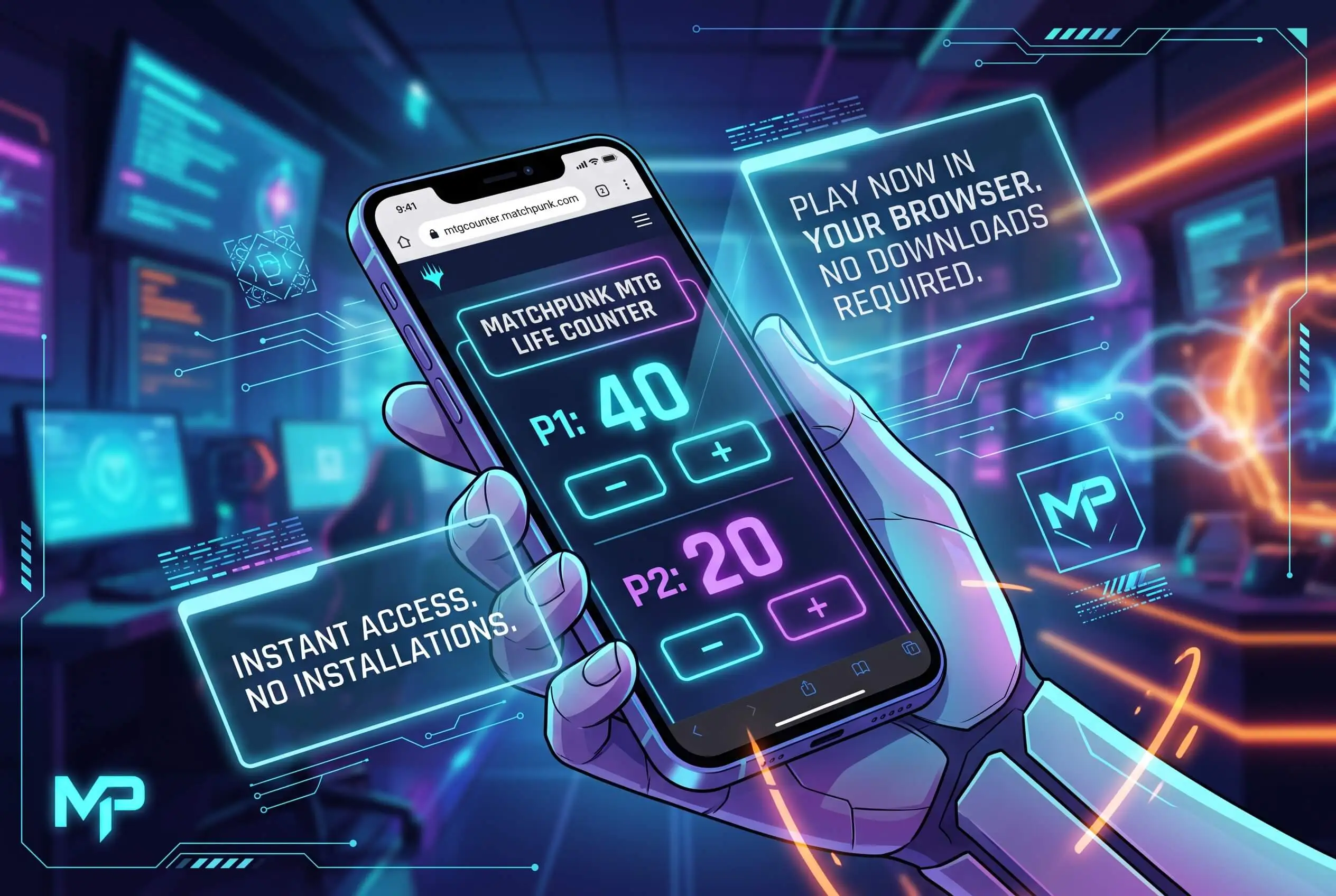
You don't have to download a thing to end that argument. A browser-based MTG life counter opens the second you tap a link and starts tracking every player right away. You tap, it loads, and you're already keeping score, with nothing to download and no account to make while the pod waits on you. What makes an MTG digital life counter app so helpful is how easily it keeps the whole table aligned: life totals stay visible, commander damage is easier to follow, counters are less likely to get missed, and the next game can start with a clean reset in seconds.
TL;DR Quick Answers
mtg digital life counter app
An MTG digital life counter app keeps every player's life total on one screen, along with commander damage, poison, energy, and the other numbers that move during a game of Magic: The Gathering. The best ones run right in your browser, so there's nothing to install. You tap a link and start tracking.
What it tracks: life, commander damage per source, poison, energy, and counters for up to 10 players at once.
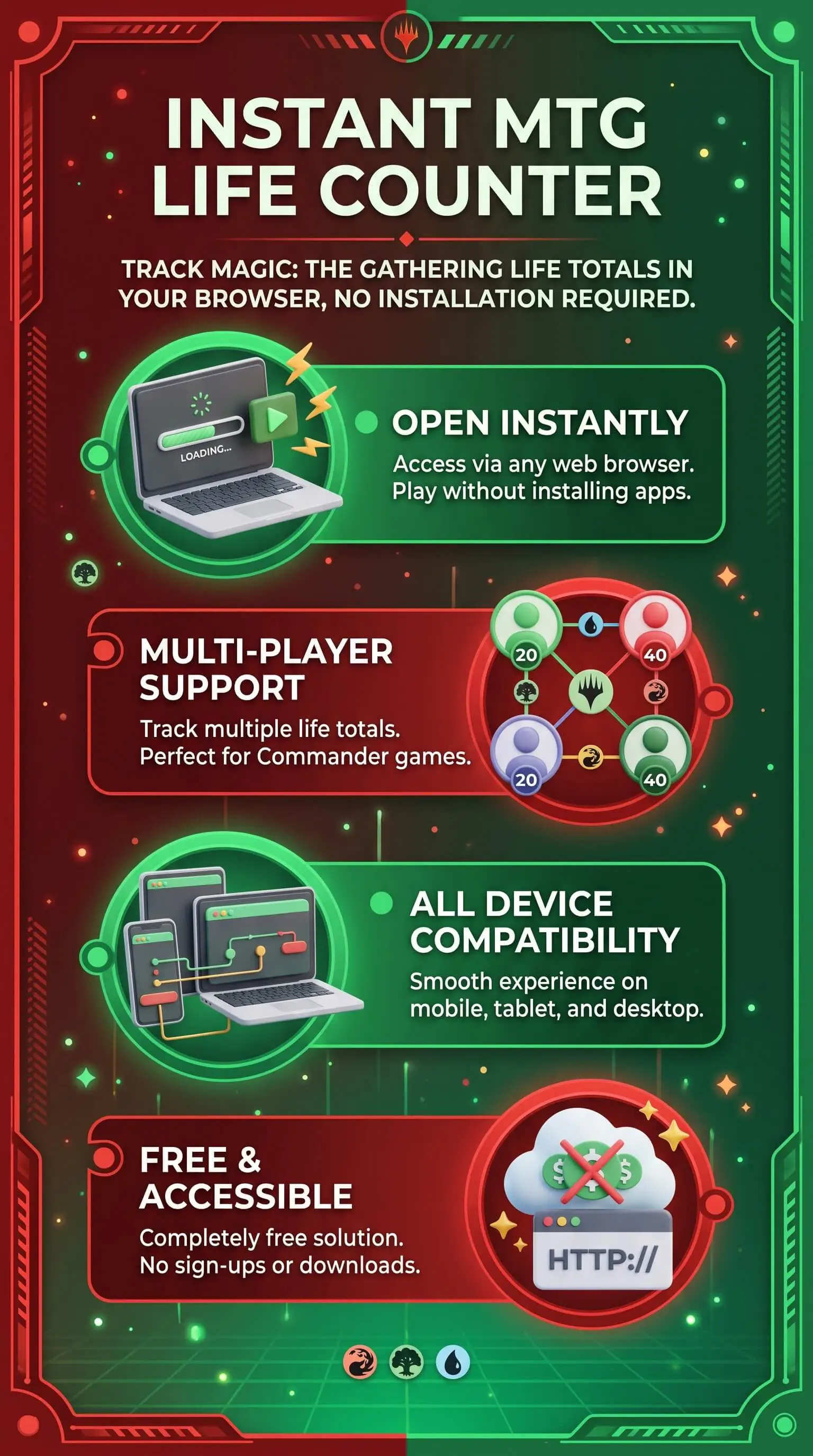
No install needed: browser-based counters open from a link on any phone, tablet, or laptop, with no app store and no account setup.
Best for: Commander and multiplayer, where 40 life each and commander damage from every seat bury a single die fast.
Still worth carrying: a spindown or dice for quick 1v1s and dead-battery nights.
Where it goes further: apps like MatchPunk save your full win-loss history and confirmation-gate every score change, so a stray tap can't rewrite the total.
Top Takeaways
You don't have to install anything to track life. A browser-based counter runs the moment you open the page.
Digital counters earn their keep in Magic: The Gathering Commander, where four players, 40 life apiece, and commander damage from every direction bury a single die fast.
No-install counters run on any device with a browser, so the whole pod can track together with nothing to download.
Physical counters still win for quick 1v1s, dead-battery moments, and competitive events that want a written life pad.
The best counter is the one with the least setup, because that's the one you'll actually open.
What a digital life counter app actually does
The job is simple. Track the number that decides the game: how much life each player has left. You start at 20 in most formats, 40 in Commander, and move it up or down as damage lands and life gain does its thing. A good digital counter goes further. It follows commander damage from each source, poison, energy, experience, and anything else your pod drops on the table, for every player at once, on a screen everyone can read.
That's where physical tools tap out. A d20 tracks one life total and nothing else. Run a four-player pod on dice and you're babysitting twenty-some changing numbers by the mid-game. A digital counter holds the whole pile and moves with a tap.
Why “no install” matters at the table
The friction was never the app. It's everything you do before you get to use it. Find it in the store. Wait for the download. Make an account. Grant permissions it probably didn't need. Meanwhile three people are shuffled up and you're the reason the game hasn't started.
A browser counter skips all of that. You open a link, it loads like any website, and nothing sticks to your phone afterward. That buys you a few real things:
You're playing in seconds. New pod at the shop, a buddy's kitchen table, the floor of a convention hall. Open the page, start tracking, done.
It runs on whatever's in your hand. Phone, tablet, laptop, the store's display. A browser tool doesn't care what operating system you're on, so there's nothing separate to install anywhere.
The whole pod can hop in. Some browser counters let every player pull the same game up on their own device, so you're not sliding one phone back and forth across the table all night.
You're always on the current version. Nothing to update, ever. Whatever loads is the latest build.
Browser app vs installed app vs physical counter
None of these wins every night. They're built for different jobs, and we'll call them how we see them.
A browser counter wins on speed and reach. It's the fastest way to get a multiplayer game tracked with zero commitment, and it's the obvious pick when you want the whole table tracking together and nobody wants to install anything.
An installed app wins when you play constantly and need it to work with no signal. If the shop's Wi-Fi dies mid-round, a downloaded app keeps humming where a web page might choke.
A physical counter wins on feel. No battery, no notifications, no screen begging for your attention. Plenty of players just like the click of a dial and the weight of a die in their hand, and for a quick 1v1, that's all you need.
Want the full head-to-head on that last one? We wrote a deep breakdown of digital versus physical counters that runs through cost, formats, tournament rules, and player types. Read it once you've decided a screen is the way you're leaning.
When a physical counter still wins
We built a digital tool, so of course we could tell you screens win every time. They don't. Grab something physical when your battery's crawling and you need the phone for pairings, when a fast 1v1 doesn't call for more than a spindown, or when you're at a Competitive REL table where the judge wants a written life pad as the record of truth. A browser counter is a great primary tool for casual and multiplayer nights. It isn't the thing you lean on when a judge call decides the match.
How to start tracking in your browser in under a minute
Open the counter's web page on anything with a browser.
Set your player count, from a 1v1 up to a full pod.
Pick the starting life, usually 20 or 40.
Switch on the counters you actually use, like commander damage or poison.
Tap to add or drop life as the game rolls. That's the whole thing.
Features worth checking before you commit
Not every browser counter is built the same, so kick the tires first. Check that it handles the player count you actually run, that it tracks commander damage per source instead of lumping it into one number, and that it won't swing a total because somebody grazed the screen. If you like knowing your record, find one that saves your game history. And if you run or play events, a counter that talks to organized-play tools saves everybody a pile of manual entry, making a digital-versus-physical life counter choice much easier for your pod.
“The mistake I see new players make is treating the life counter as an afterthought. In our pods, the games that fall apart are almost always the ones where somebody tried to hold four life totals and commander damage in their head. A browser counter you can open on the spot kills that whole failure point. You stop arguing about whether someone was at 12 or 14 and get back to playing. After running store leagues for years, I tell every group the same thing: pick the tool with the least setup, because the one you'll actually use is the one that's ready when the game starts.”
7 Essential Resources
Where we send players who want to go deeper on the rules, the cards, and the Commander format that makes a digital counter worth carrying.
Scryfall. The fast card search nearly everyone uses to check rulings, mana costs, and card text mid-game.
EDHREC. Real data on which commanders and cards people are running right now, plus ideas for your next build.
Star City Games: Discover Commander. A clean beginner's walkthrough of how the format works and how to build a first deck.
MTG Wiki: Commander. A detailed community reference for the format's rules, history, and variants.
Wikipedia: Magic: The Gathering Commander. The backstory on how EDH went from a fan format to the official one.
Wizards of the Coast: Commander Play events. Official word on in-store Commander events and Two-Headed Giant nights.
TCGplayer: What Is a Commander? Another solid primer if you're still learning the most popular way to play.
3 Statistics
Magic pulled in $1.72 billion across tabletop and digital in fiscal 2025, and cleared a billion for the first time back in 2022. That's a lot of players hunting for a smoother way to keep score. Source: Hasbro investor relations.
Commander is Magic's most popular multiplayer format, straight from Wizards of the Coast. Four players, 40 life each, commander damage flying in from every seat: that's the exact game that buries a single die. Source: Wizards of the Coast.
Roughly 91% of U.S. adults own a smartphone, up from 35% in 2011. The device that runs a browser counter is already in nearly every pocket at the table. Source: Pew Research Center.
Magic’s growth, Commander’s multiplayer demands, and near-universal smartphone access all point to the same thing: just as organic farming favors cleaner, more efficient systems, MTG players are moving toward smoother digital life tracking that keeps every life total and commander damage count easier to manage.
Final Thoughts and Opinion
Our honest take? If you play Commander or any multiplayer format with any regularity, you want a digital life counter, and a browser-based one is the least-friction way to get there. Open, track, play. You skip the download, the account wall, and the wait on the app store.
That doesn't mean you retire your dice. Keep a spindown in the bag for fast 1v1s and dead-battery nights, and bring a life pad if competitive events are on your calendar. The players who never argue about life totals aren't the ones with the fanciest gear. They're the ones who grabbed the right tool the second the game started, much like an organic farming PPT works best when every key detail is organized, easy to follow, and presented in the right place. For most casual and Commander tables, that tool opens in a browser.
Frequently Asked Questions
Can I use an MTG life counter without installing an app?
Yes. A browser-based MTG life counter runs in any mobile or desktop browser with no download and no account. Open the page and you're tracking life totals right away.
How many players can a digital MTG life counter track?
Most browser counters handle up to 10 players, which covers everything from a 1v1 Standard game to a full Commander pod.
Does a browser life counter work for Commander?
Yes, and that's where it helps most. Commander starts everyone at 40 life and piles on commander damage, poison, and other counters, which is far more than a single die tracks cleanly.
What happens if I close the browser mid-game?
Depends on the tool. Some browser counters save your game state so you can jump back in, while others reset. If you play long games, pick one that holds your session.
Is a no-install counter good enough for tournaments?
For casual and most in-store play, yes. At Competitive REL, the judge expects a written life total as the official record, so keep a life pad as your primary there and let the app ride along as backup.
Do I need the internet to use a browser-based life counter?
To load the page, yes. Once it's open, some counters keep working even if your signal drops, but that first load needs a connection, so test it before you count on it at a spotty venue.
CTA
Done chasing a runaway d20 around the table? Open a browser-based MTG life counter, set your starting life, and track the whole pod on one screen. No download, no account, no waiting. Click or tap here to start your next game.