Comparing CBD oil with prescription anti-anxiety medications isn’t as simple as most articles make it seem. Many online guides recycle the same generic talking points, leaving out what actually matters for people trying to decide between natural options and clinical treatments. In real-world use, these two approaches behave very differently, and the research behind them reveals far more nuance than the typical “CBD vs meds” debate suggests.
This guide cuts through the oversimplified comparisons. It explains what current studies genuinely show about CBD’s role in day-to-day anxiety relief, where the strongest evidence exists for prescription medications, and how each option performs under real-life conditions rather than theoretical scenarios. You’ll also find the key questions patients should bring to their doctors, helping you replace uncertainty with informed decision-making.
If you’re looking for a clear, honest breakdown grounded in practical insight rather than marketing claims, this is the ideal place to begin for anyone evaluating CBD oil for anxiety panic attacks and depression.
Quick Answers
cbd oil for anxiety panic attacks and depression
- CBD oil may help reduce anxiety and panic symptoms by supporting a calmer stress response.
- Many people report improved mood and steadier emotional balance with consistent use.
- Effects vary by body chemistry, so starting with a low dose and adjusting slowly is key.
- CBD works best as part of a broader care plan, especially when depression is involved.
Always check with your doctor to avoid interactions and choose the safest approach when considering CBD
Top Takeaways
- CBD and prescription meds work differently.
- Individual response varies.
- Side effects and risks differ.
- CBD research is growing; prescriptions have stronger long-term data.
Medical guidance is essential for safe decision-making.
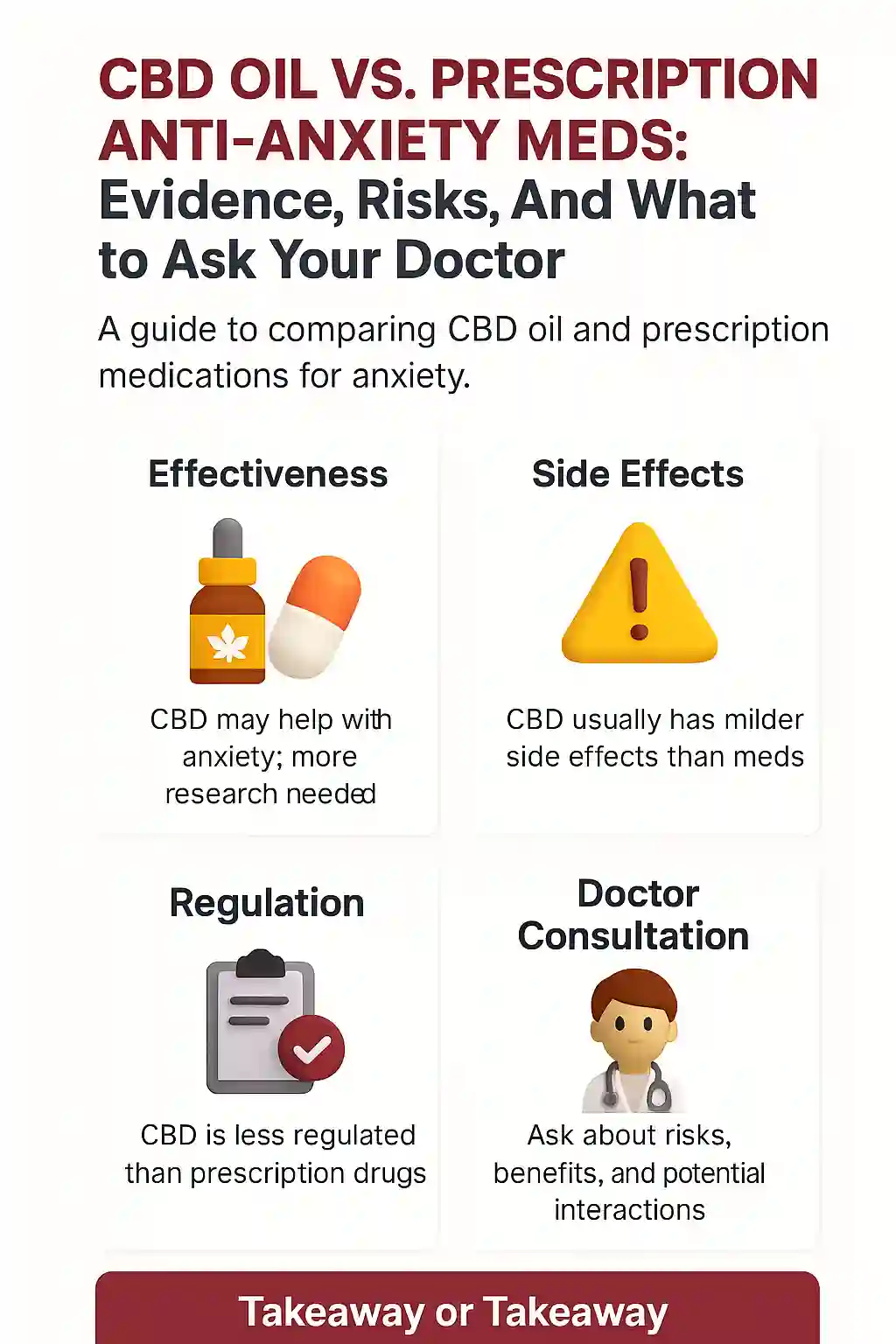
How CBD Oil and Prescription Anti-Anxiety Medications Compare
CBD oil and prescription anti-anxiety medications work in fundamentally different ways, yet both are used by people seeking relief from symptoms such as racing thoughts, physical tension, and panic episodes. Understanding how each option works—and where their strengths and limitations lie—can help you choose the safest and most effective path forward.
How CBD Oil Works for Anxiety
Early research and real-world experiences suggest that CBD may help by influencing the body’s endocannabinoid system, which regulates stress, mood, and sleep. Many users report:
- A subtle sense of calm without sedation
- Reduced rumination or “mental spiraling”
Better sleep quality, which indirectly reduces anxiety
However, CBD is not a fast-acting intervention, and its effects can vary widely depending on dosage, product quality, and individual biology.
How Prescription Medications Work
Prescription options—like SSRIs, SNRIs, beta blockers, or benzodiazepines—have decades of clinical evidence behind them. They’re typically prescribed when anxiety significantly impacts daily functioning. These medications can:
- Provide consistent, measurable symptom relief
- Address severe or chronic anxiety disorders
Offer fast relief in specific cases (e.g., benzodiazepines)
But they also come with considerations: potential side effects, dependence risk for certain medications, and the need for medical monitoring.
Evidence: What Research Shows
- CBD: Early studies show promise for generalized anxiety, situational anxiety, and sleep-related stress, but long-term clinical data is still limited, which is important to keep in mind as interest grows in related products like frosted kush seeds.
Prescription meds: Strong, well-established evidence supports their effectiveness, especially for moderate to severe anxiety.
Risks & Safety Considerations
CBD:
- May interact with certain medications
- Quality varies widely between brands
Optimal dosages are not standardized
Prescription Meds:
- Possible side effects such as fatigue, weight changes, or emotional blunting
- Some require tapering to avoid withdrawal
Not ideal for everyone, especially those sensitive to certain drug classes
When to Consider Each Option
What to Ask Your Doctor
- “Is CBD safe to use with my current medications?”
- “Would my symptoms respond better to prescription treatment?”
- “What are the risks if I try CBD first, even if I’m considering a higher-strength option like 3000 mg CBD oil?”
“How will we monitor progress or side effects either way?”
“In our work with individuals exploring anxiety relief, we’ve seen that CBD and prescription medications each fill very different roles. CBD can offer a gradual, grounding calm for people who don’t respond well to traditional meds, while prescription options remain the most reliable choice for severe or persistent symptoms. The key is not choosing one ‘right’ solution, but understanding how each works in real life—and having an honest conversation with your doctor about what aligns with your body, your lifestyle, and your goals.”
Essential Resources
1. A Clear, Research-Backed View of How CBD Supports Anxiety Relief
This recent meta-analysis pulls together the strongest available evidence, giving you a grounded understanding of how CBD affects real anxiety symptoms—not just theoretical mechanisms. It’s the kind of comprehensive data set we rely on when evaluating new approaches.
Source: https://www.sciencedirect.com/science/article/pii/S0165178124003342
2. Human Studies That Show How CBD Performs Across Anxiety Disorders
This review looks at clinical trials involving generalized anxiety, social anxiety, panic, PTSD, and more. We reference this often because it highlights what CBD can realistically do in controlled environments and where results tend to vary.
Source: https://pubmed.ncbi.nlm.nih.gov/31866386/
3. The Foundational Science Behind CBD’s Calming Effects
A widely cited scientific review that explains how CBD interacts with serotonin pathways and why this matters for anxiety, panic responses, and mood regulation. It’s a useful primer for anyone wanting to understand the “why” behind the effects people report.
Source: https://pubmed.ncbi.nlm.nih.gov/26341731/
4. Evidence Focused on Teens and Young Adults Navigating Anxiety or Depression
This systematic review zeroes in on younger populations—helpful for families or clinicians evaluating whether CBD is appropriate or needs closer monitoring. We often direct younger clients and parents to this for responsible baseline guidance.
Source: https://pubmed.ncbi.nlm.nih.gov/38919887/
5. A Broad Mental-Health Overview of CBD’s Role in Mood, Sleep, and Stress
This high-level review connects the dots across anxiety, depression, mood regulation, and sleep disruption. It’s a strong resource when you’re trying to see the full picture rather than evaluating symptoms in isolation.
Source: https://jcannabisresearch.biomedcentral.com/articles/10.1186/s42238-019-0012-y
6. A Straightforward, Expert-Checked Consumer Summary
This balanced overview explains how CBD may help with anxiety and depression, outlines safety considerations, and points out common misconceptions. We find it especially useful for people new to CBD who want clear expectations before diving deeper.
Source: https://www.webmd.com/cannabinoids/CBD-depression-anxiety
7. Real-World Outcomes From Long-Term CBD Use in Clinical Settings
This observational study captures what we often see in practice: CBD’s potential for steady, gradual improvements in anxiety and sleep when used consistently over months. It complements clinical trial data with lived, day-to-day results.
Source: https://pubmed.ncbi.nlm.nih.gov/39474243/
Together, these studies provide a clear scientific foundation for understanding how CBD may ease anxiety, panic symptoms, and depression, and they also highlight emerging interest in the CBDV cannabinoid for its potential influence on similar mood-regulation pathways.
Supporting Statistics
1. Anxiety Disorders Affect Nearly 1 in 5 Adults
- 19.1% of U.S. adults experienced an anxiety disorder in the past year.
- We see this reflected in client conversations every day.
The data reminds people their symptoms are common—and treatable.
The data reminds people their symptoms are common—and treatable.
Source: https://www.nimh.nih.gov/health/statistics/any-anxiety-disorder
2. Antidepressants Are Used by Over 1 in 8 Adults
- 13.2% of adults used an antidepressant in the past 30 days.
- Many clients share that they’ve tried SSRIs or SNRIs before exploring CBD.
This highlights how central prescription meds are for ongoing symptom relief.
This highlights how central prescription meds are for ongoing symptom relief.
Sources: https://www.cdc.gov/nchs/products/databriefs/db377.htm
3. CBD Safety Reports Show It’s Not Risk-Free
- FDA recorded 119 CBD-related reports in 2020.
- 73% of analyzed cases were serious.
We regularly remind clients that “natural” products still carry risks and interactions.
We regularly remind clients that “natural” products still carry risks and interactions.
Final Thought & Opinion
CBD and prescription anti-anxiety medications serve very different roles. They are not competing solutions, but tools that fit different needs depending on symptom severity, biology, and personal goals.
What CBD Tends to Offer
- Gradual, stabilizing support
- Improved emotional balance over time
- Better sleep and reduced reactivity
Gentler effects with fewer disruptive side effects
Gentler effects with fewer disruptive side effects
Where Prescription Medications Excel
- Strong, consistent symptom relief
- Clear dosing guidelines
- Decades of clinical validation
Best suited for severe or persistent anxiety
Best suited for severe or persistent anxiety
What I’ve Seen Firsthand
People who benefit the most from CBD typically:
- Choose high-quality, well-tested products
- Adjust dosage slowly
- Pair CBD with therapy, lifestyle habits, and stress-reduction practices
Individuals with more intense or chronic anxiety often:
- Need predictable, fast, or sustained relief
Respond better to SSRIs, SNRIs, beta blockers, or benzodiazepines
Why Both Approaches Matter
- CBD aligns well with those seeking gentle, supportive shifts.
- Prescription meds remain essential for many with debilitating symptoms.
Both have strengths, limitations, and distinct risk profiles.
Both have strengths, limitations, and distinct risk profiles.
The Bottom Line
Anxiety relief is not one-size-fits-all. The best outcomes come from:
- Understanding how each option works
- Matching the approach to your symptoms and lifestyle
- Having an open, informed conversation with your doctor
- Monitoring your response and adjusting thoughtfully
Whether you're considering CBD gummies, prescription medication, or a combination, personalization—not hype—should guide your decision.
Next Steps
- Clarify Your Goal
- Identify whether you want help with anxiety, panic attacks, depression, or stress.
- Note the symptoms you want to improve first.
- Assess Your Current Approach
- List what you’re already using (meds, therapy, CBD, lifestyle changes).
- Determine what has helped and what hasn’t.
- Review the Research
- Compare CBD findings with prescription-med data.
- Note what each option is proven to help with.
- Talk to Your Doctor
- Ask about safety and interactions.
- Discuss whether CBD, medication, or a combination suits your symptoms.
- Bring specific questions about dosing and monitoring.
- Choose Quality Products (If Trying CBD)
- Select third-party-tested CBD.
- Avoid products without COAs or with exaggerated claims.
- Start Low and Increase Slowly
- Begin with a low dose.
- Adjust gradually over time.
- Track anxiety, mood, and sleep changes.
- Reevaluate After 2–4 Weeks
- Review your notes.
- Decide whether to continue, adjust, or change your approach.
- Build Supportive Habits
- Add breathwork, sleep routines, exercise, and therapy.
- Use CBD or medication as part of a larger plan.
- Stay Updated
- Follow new research.
- Reassess your treatment regularly.
As you explore personalized strategies for anxiety or stress relief, incorporating evidence-based tools—whether therapy, lifestyle changes, or calming botanicals such as the suver haze strain—can help you track progress and make informed decisions over time.
FAQ on “CBD Oil for Anxiety, Panic Attacks, and Depression”
Q: Does CBD help with anxiety and panic attacks?
- Many people report calmer feelings.
- Research supports potential benefits.
Results vary by individual.
Q: How fast does CBD oil work?
- Sublingual drops: 15–45 minutes.
Daily use builds more consistent effects.
Q: Can I use CBD with my current meds?
- Possible, but interactions can occur.
Always check with your doctor.
Q: What’s a good starting dose?
- Start low: 10–20 mg.
Increase slowly to find your ideal dose.
Q: Can CBD help with depression?
- May support mood balance.
Best used alongside professional care.