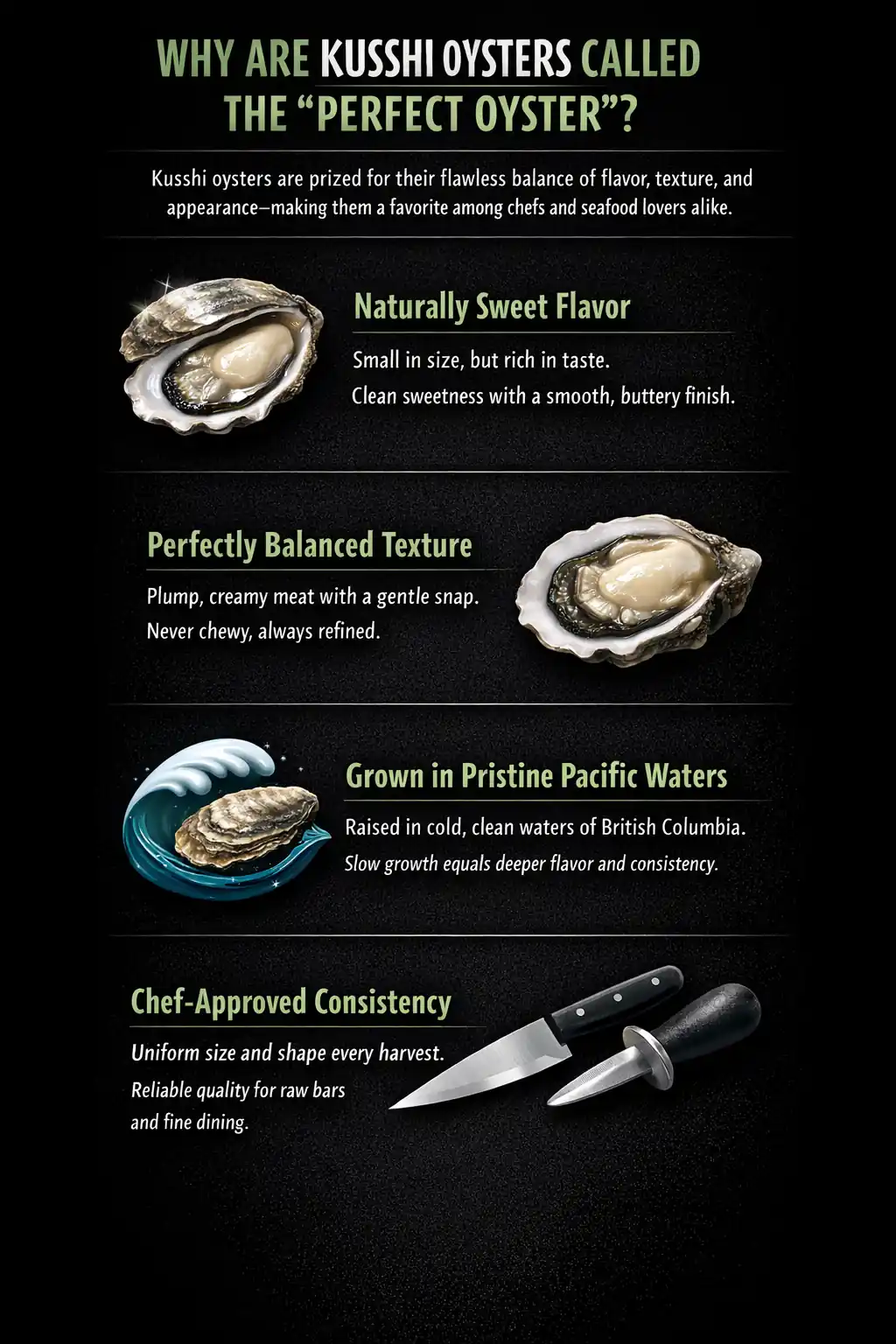
Because they deliver what chefs value most: consistency. After years of sourcing oysters for raw bars and tasting them side by side, many chefs point to Kusshi oysters for their reliably clean sweetness, deep cup, and tender bite—qualities that don’t fluctuate with the season. Grown slowly in cold Pacific waters using carefully controlled farming methods, Kusshis develop a balanced flavor that’s mild enough for first-timers yet refined enough for professionals.
This page breaks down why chefs and seafood buyers repeatedly choose Kusshi oysters, how their farming process shapes flavor and texture, and what makes them stand out from other premium oyster varieties.
TL;DR Quick Answers
Kusshi Oysters
Kusshi oysters are a premium, farmed Pacific oyster known for their small size, deep cup, and clean, mildly sweet flavor. They’re called the “perfect oyster” because their slow, controlled growth produces consistent texture and taste year-round—making them a reliable favorite for chefs, raw bars, and first-time oyster eaters alike.
Top Takeaways
Consistency defines Kusshi oysters.
Reliable size, flavor, and texture year-round.Farming drives quality.
Slow growth and controlled aquaculture create balance and depth.Easy to enjoy, hard to outgrow.
Approachable for beginners, refined for experienced oyster lovers.Trusted by professionals.
Chefs favor Kusshis for predictable service and low variability.Backed by sustainability and safety.
Responsible farming and alignment with U.S. standards add confidence.
What Makes Kusshi Oysters Different From Other Oysters?
Kusshi oysters are selectively bred and farmed for balance—something chefs and oyster buyers immediately notice. Unlike many wild oysters that vary widely in size, salinity, and texture, Kusshis are cultivated to grow slowly in cold Pacific waters. This slower growth produces a naturally deep, cup-shaped shell and a higher meat-to-shell ratio, making them visually appealing and easier to serve on the half shell.
From a sourcing standpoint, chefs often describe Kusshis as “low risk, high reward.” Their uniform size and predictable quality allow raw bars to serve a consistent experience, regardless of season.
Flavor Profile: Why Chefs Call Kusshi Oysters “Perfect”
Kusshi oysters are known for their clean, subtly sweet flavor with light cucumber and melon notes, followed by a smooth, buttery finish. They lack the sharp brininess or metallic aftertaste found in some oysters, which is why chefs frequently recommend them to first-time oyster eaters.
Because Kusshis are grown in controlled environments with stable salinity and nutrient levels, their flavor remains balanced and approachable—something chefs rely on when building curated raw bar menus.
How Farming Methods Shape Kusshi Oyster Quality
Kusshi oysters are not wild-harvested; they’re purposefully farmed using advanced aquaculture techniques. Raised off-bottom and carefully rotated during growth, they develop stronger shells and plumper meat. This hands-on process minimizes stress on the oyster, contributing to their tender texture and clean finish.
Seafood professionals often point out that this controlled farming approach is what allows Kusshi oysters to maintain premium quality year-round—an advantage few oyster varieties can match.
Why Kusshi Oysters Are Ideal for Both Beginners and Connoisseurs
What ultimately earns Kusshi oysters their “perfect oyster” reputation is versatility. Their mild sweetness makes them accessible for newcomers, while their refined texture and balance satisfy experienced oyster lovers. For chefs, that rare overlap is invaluable.
Whether served plain, with a classic mignonette, or paired with champagne, Kusshi oysters consistently deliver the same result: a dependable, high-quality oyster experience that offers a lighter, cleaner contrast to escolar, a fish known for its rich texture and more divisive dining reputation.
“After years of sourcing oysters for raw bars, Kusshis are the one variety we can rely on without hesitation. Their flavor stays clean and balanced, their size is consistent, and the texture never surprises you—which is exactly why chefs call them the ‘perfect oyster.’”
Essential Resources
Official Kusshi Oysters Website — Direct Sourcing & Specs
Go straight to the source for the most accurate details on Kusshi oyster sizing, availability windows, and official distributor contacts. This is where professional buyers start when confirming supply chains and ordering volumes.
https://kusshioysters.com/
The Oyster Guide — Compare Kusshi With Other Varieties
A reliable reference for training staff on how Kusshi’s deep cups and clean flavor compared to other oysters, helping chefs build balanced oyster lists and tasting flights.
https://www.oysterguide.com/maps/british-columbia/kusshi/
Pangea Shellfish Oysterology — Flavor & Growing Conditions
Provides terroir-specific insight into Kusshi’s Baynes Sound growing conditions and flavor profile, useful for menu descriptions and guest education.
https://www.pangeashellfish.com/oysterology/kusshi-oyster
BC Shellfish Growers Association — Sustainability Standards
Outlines British Columbia’s shellfish sustainability practices and industry standards, supporting transparent sourcing conversations with guests and buyers.
https://bcsga.ca/sustainability/
Seafood Watch — Environmental & Sustainability Ratings
An up-to-date reference for oyster sustainability recommendations, helping chefs and consumers align Kusshi oysters with responsible sourcing policies.
https://www.seafoodwatch.org/seafood-recommendations/groups/oysters/overview
FDA Seafood Safety Guidelines — Storage & Handling Compliance
A critical food-safety resource covering shellfish storage, temperature control, and tag retention requirements for commercial kitchens.
https://www.fda.gov/food/buy-store-serve-safe-food/selecting-and-serving-fresh-and-frozen-seafood-safely
Hog Island Oyster Co. — Shucking & Service Techniques
A respected industry guide offering practical shucking and handling techniques well suited to Kusshi’s uniform shell shape and size.
https://hogislandoysters.com/recipe/shuck/
Together, these resources give chefs and buyers a complete, professional view of Kusshi oysters—from sourcing and sustainability to handling and service—placing them alongside hake fish as a dependable, well-documented choice for kitchens that prioritize consistency, transparency, and performance.
Supporting Statistics
Food Safety & Controlled Farming
The CDC estimates ~80,000 vibriosis cases per year in the U.S.
Most cases are linked to raw or undercooked shellfish, especially oysters.
In practice, this is why chefs favor controlled aquaculture oysters, where harvest timing, water quality, and handling are tightly managed.
Source: https://www.cdc.gov/vibrio/about/index.html
Why Oysters Dominate U.S. Aquaculture
NOAA reports over 80% of U.S. marine aquaculture value comes from bivalves like oysters.
From a sourcing standpoint, this reflects reliability, year-round availability, and consistency—the same traits professionals look for in premium oysters like Kusshi.
Source: https://www.fisheries.noaa.gov/national/aquaculture/us-aquaculture
Environmental Performance Matters
NOAA notes a single oyster can filter up to 50 gallons of water per day under ideal conditions.
This natural filtration is why responsibly farmed oysters are often considered one of the lowest-impact animal proteins and frequently highlighted on sustainability-focused menus.
Source: https://www.fisheries.noaa.gov/national/habitat-conservation/oyster-reef-habitat
Market Scale & Buyer Confidence
USDA data shows U.S. aquaculture sales exceeded $1.9 billion.
That scale supports stable distribution and consistent supply, helping premium farmed oysters remain available when wild harvests fluctuate.
Source: https://www.nass.usda.gov/Publications/AgCensus/2022/Online_Resources/Aquaculture/aqua_1_001_001.pdf
Taken together, these statistics explain why chefs trust tightly controlled oyster aquaculture for safety, sustainability, and consistency—priorities that stand apart from sourcing considerations for high-quality skate fish, which rely on very different harvest and handling dynamics.
Final Thought & Opinion
After sourcing and serving oysters across multiple regions, Kusshi oysters consistently stand out for one key reason: reliability. Their size, flavor, and texture are predictable—qualities that matter as much in professional kitchens as they do for diners.
What makes Kusshi oysters feel “perfect” in practice:
Consistency: Clean sweetness and tender texture with minimal variation.
Intentional farming: Bred and grown for balance, not extremes.
Low risk for service: Chefs can serve them confidently, season after season.
From a firsthand, professional perspective:
Kusshi oysters remove uncertainty from menus and raw bars.
They’re approachable for first-time oyster eaters.
They still satisfy experienced oyster lovers looking for refinement.
The real value of Kusshi oysters isn’t hype or rarity—it’s confidence. In an industry full of variables, Kusshis deliver balance, craftsmanship, and restraint every time, which is why many consider them as close to a “perfect oyster” as it gets.
FAQ on Kusshi Oysters
Q: What does a Kusshi oyster taste like?
A: Kusshi oysters have a clean, mildly sweet flavor with subtle cucumber and melon notes and a smooth finish. Chefs often recommend them because they avoid the sharp brine or metallic taste found in some oysters.
Q: Why are Kusshi oysters smaller in size?
A: Kusshi oysters are bred for slow, controlled growth. Their smaller size creates a higher meat-to-shell ratio and a deep cup that is easier to plate and serve consistently.
Q: Are Kusshi oysters farmed or wild?
A: Kusshi oysters are farmed using modern aquaculture techniques. This approach results in predictable flavor, tender texture, and dependable year-round availability.
Q: Are Kusshi oysters good for beginners?
A: Yes. Their mild sweetness, low brininess, and soft texture make Kusshi oysters one of the most approachable choices for first-time oyster eaters.
Q: Where are Kusshi oysters grown?
A: Kusshi oysters are grown in the cold waters of British Columbia, where slower growth contributes to their clean taste, firmness, and consistent quality.