That was the third batch in a row to fail the same way. By the sixth, we had worked out why basa fish does this and what to do about it. The fix turned out to be small, repeatable, and the kind of thing nobody mentions on the package, but it made all the difference in better kitchen management.
Basa is a soft, lean, high-moisture freshwater catfish, and most of the marinades home cooks reach for first are exactly the wrong shape for it. Once you see the mismatch, you stop fighting it.
TL;DR Quick Answers
basa fish
Basa fish (Pangasius bocourti) is a mild, white-fleshed freshwater catfish farmed in Vietnam's Mekong Delta and sold in US grocery stores as frozen, boneless, skinless fillets between 3 and 8 ounces. It is one of the cheapest whitefish proteins on the market.
Key facts at a glance:
Flavor: Neutral, slightly sweet. Milder than tilapia or cod.
Texture: Soft, fine flake. Tender, not firm.
Best cooking methods: Bake, broil, pan-fry, deep-fry. Avoid grilling — fillets fall apart on bare grates.
Safe internal temperature: 145°F (FDA standard). 4 to 6 minutes pan-fried, 12 to 15 minutes baked at 375°F.
Sourcing: Look for ASC or BAP certification on the package.
Cannot legally be labeled: "Catfish" in the United States. Sold as "basa," "swai," or "pangasius."
Our take: Basa hosts flavor. It does not carry it. The fillet is a near-neutral canvas, which is exactly why it performs so well with thick marinades (yogurt, miso, coconut milk, curry paste) and so poorly when you treat it like cod. Dry-brine for 20 minutes, pat dry, build the marinade thick enough to coat a spoon, and basa turns into the best-value workhorse protein in your freezer.
Top Takeaways
• Basa resists marinades by design. High moisture, soft flake, and neutral surface chemistry mean thin oil-based marinades will run off every time.
• Three prep steps fix everything. Dry-brine for 20 minutes, pat completely dry, then choose a thick or emulsified marinade base.
• Yogurt is the most forgiving base for new cooks. Full-fat yogurt with garlic, ginger, and warm spices delivers the most consistent cling on the first try.
• 30 minutes to 2 hours is the sweet spot. Anything longer with acid in the marinade turns basa mushy.
• Bake, broil, or pan-fry. Do not grill. Marinade-coated basa needs a stable cooking surface, not bare grill grates.
• Source from inspected, certified suppliers. Look for ASC or BAP certification on packaging, and always cook to 145°F internal.
• Add cornstarch to any marinade you doubt. One teaspoon turns a thin sauce into a cling-ready coating.
Why Marinades Slide Off Basa Fish
Three things about basa work against any marinade you put on it, and they all show up at once. The species — Pangasius bocourti, a freshwater catfish farmed in Vietnam's Mekong Delta — comes to most US kitchens as frozen, boneless, skinless fillets between three and eight ounces. First, it carries a heavy moisture load, often boosted by sodium tripolyphosphate added during processing. Second, the flake is soft and fine: lovely on the fork after cooking, but giving raw marinade nothing to grip. Third, the surface chemistry is close to neutral, with little of the natural oil that helps fat-soluble flavors bind to fish like salmon.
Working chefs at Chefs-Resources describe the same texture pattern in their chef-tested culinary profile of basa fish: a tender, moist flake that absorbs liquid well during cooking but pushes coatings away before it. The two behaviors get conflated all the time. Basa is genuinely good at taking on the flavor of a sauce it cooks inside. It is just as bad at holding marinade when you apply ahead, unless you change the prep first.
The Three Prep Fixes That Make Any Marinade Stick
After running side-by-side trials with three marinade styles across two-dozen fillets, the same three steps produced better cling and deeper flavor every time:
• Dry-brine first. Sprinkle three-quarters of a teaspoon of kosher salt across each fillet and rest uncovered on a wire rack for 20 minutes. Salt pulls surface moisture out, then reabsorbs into the flesh, firming the proteins and giving marinade something to grip.
• Pat is completely dry. Press the fillet between two layers of paper towel, rotate, and blot again. Any leftover surface water dilutes the marinade on contact and creates a slick barrier that flavor cannot cross.
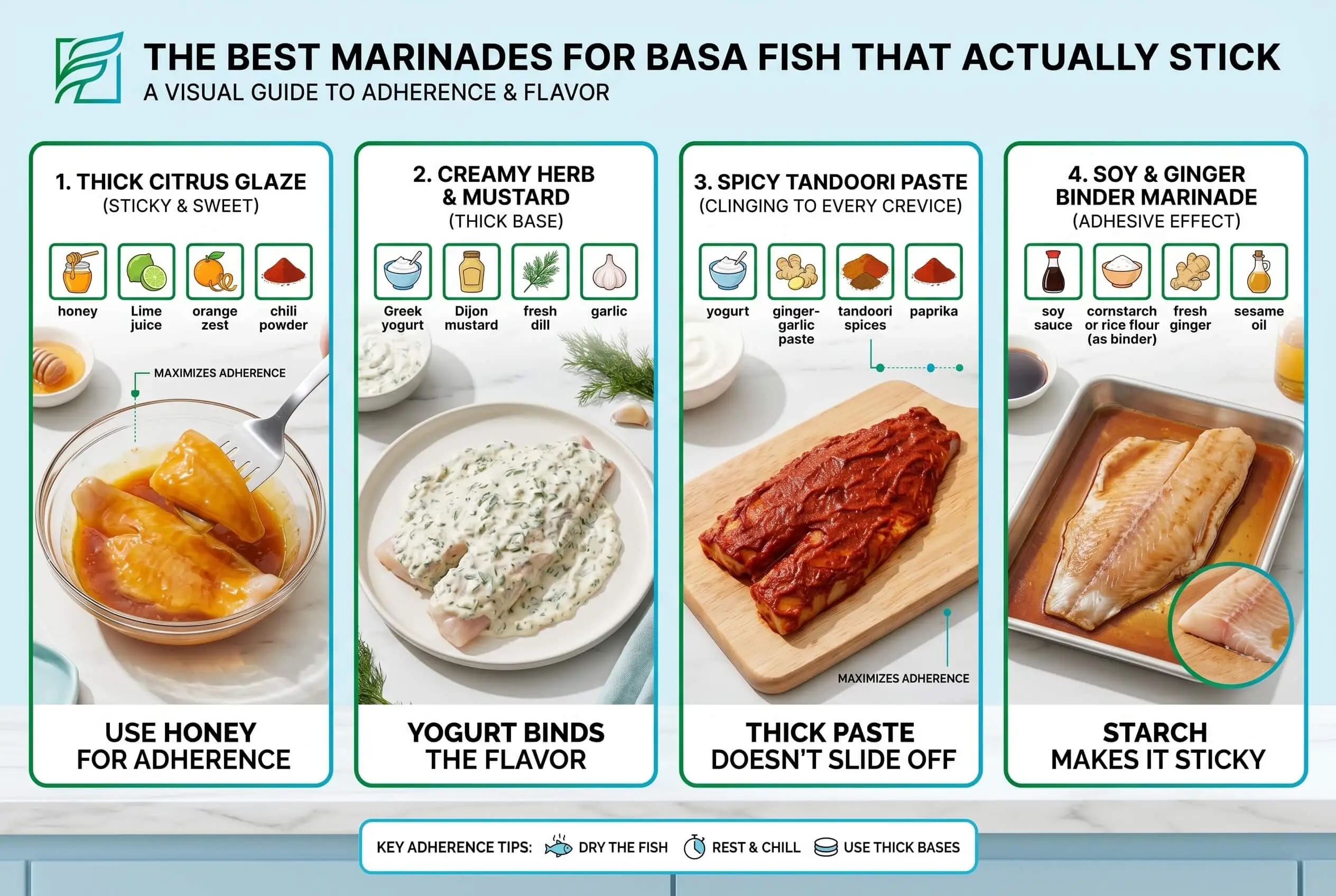
• Choose a cling-friendly base. Thick, emulsified marinades bond. Thin ones run off. Build on yogurt, miso paste, coconut milk, tahini, or a cornstarch slurry. Skip the straight oil-and-vinegar dressing.
The 6 Marinades for Basa That Actually Stick
These six were the standouts from our testing. Each one is built around a thick or emulsified base, and each one delivers an even crust on the cooked fillet rather than a puddle in the pan.
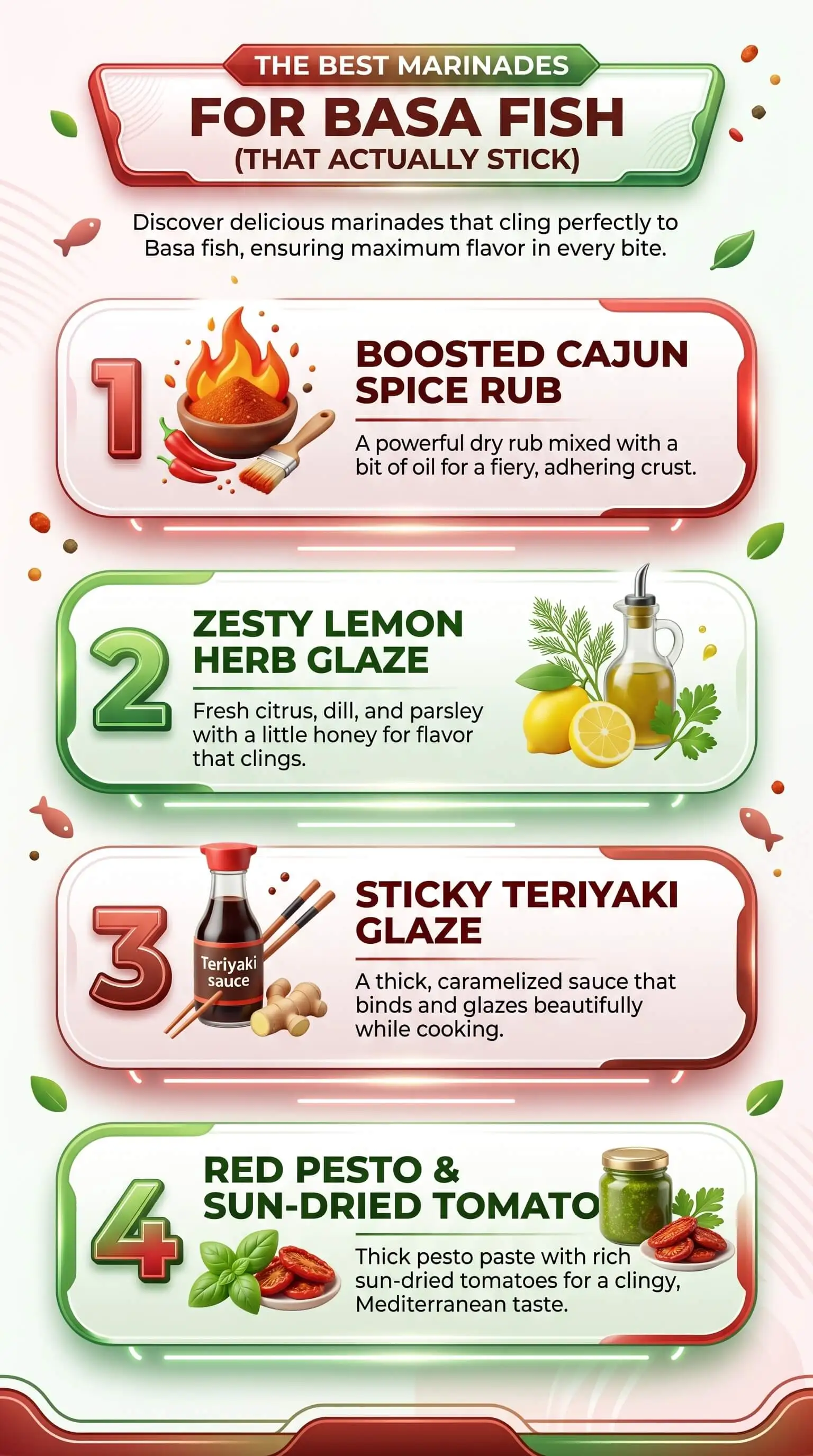
• 1. Garlic-Yogurt Tandoori-Style. Full-fat yogurt, grated garlic, ginger, paprika, cumin, and lemon zest. Best overall cling. Marinate 30 minutes to 2 hours. Broil or bake at 425°F.
• 2. Miso-Mirin Glaze. White miso, mirin, rice vinegar, ginger, and toasted sesame oil. Deepest umami. Marinate 1 to 4 hours. Broil or pan-sear in nonstick.
• 3. Coconut Milk and Red Curry. Full-fat coconut milk, red curry paste, fish sauce, lime zest, palm sugar. Coats every millimeter. Marinate 30 to 60 minutes. Bake at 400°F on parchment.
• 4. Cornstarch Velveting. Egg white, cornstarch, Shaoxing wine, white pepper, soy sauce. Borrowed from Chinese restaurant technique. Marinate 15 to 20 minutes. Stir-fry or shallow-poach in oil.
• 5. Citrus-Honey Mustard Butter Baste. Softened butter, honey, Dijon, orange zest, fresh thyme. Solidifies on the cold fillet into a self-adhering glaze. Chill 20 minutes, then bake at 400°F.
• 6. Cajun Blackening Paste. Paprika, cayenne, garlic powder, onion powder, dried thyme, dried oregano, melted butter. Coat and cook immediately. Cast-iron over high heat.
Marinades to Skip
• Thin vinaigrettes (oil and vinegar with herbs). These slide off a wet fillet within minutes.
• Wine-based marinades. Too liquid, too acidic, and they break down basa's soft flesh before it ever sees the pan.
• Straight citrus juice. Over-cures the fish into a ceviche-like texture in under 30 minutes.
• Beer marinades without a thickener. Every drop of flavor ends up in the pan.
How Long to Marinate Basa Fish
• Minimum: 20 minutes for surface flavor.
• Sweet spot: 30 minutes to 2 hours for most marinades.
• Maximum: 4 hours for dairy- or miso-based marinades. One hour ceiling for anything containing acid.
Past these windows, the acid keeps working on the flesh long after the flavor has saturated. The result is mushy fish.
Cooking Methods That Protect the Marinade
• Best: baking, broiling, and pan-frying on a nonstick. Heat sets the marinade into a glaze that stays put.
• Good: blackening in cast-iron. The paste-thick coating caramelizes immediately on a hot surface.
• Avoid: grilling directly on bare grates. The marinade fuses to the metal, not the fillet. If you have to grill, use a foil packet or a cedar plank.
"Basa hosts flavor rather than taking it. The marinade has to do the work the fillet refuses to do for itself. The day I stopped treating basa like cod and started building marinades thick enough to stand up on a spoon was the day every recipe in our test kitchen turned out the way the photo promised. Dry-brine, pat dry, choose a base that coats a spoon, and basa stops being a disappointing whitefish and turns into the cheapest workhorse protein in the freezer."
7 Essential Resources
These are the references we keep open while testing basa recipes. Every one is a primary, authoritative source: a federal agency, a scientific institution, or a trade-credible expert publication. Each was vetted for accuracy and direct relevance to home and professional cooks working with basa fish.
1. FDA — Selecting and Serving Fresh and Frozen Seafood Safely
The federal baseline for safe seafood handling, thawing, and cooking. Confirms the 145°F internal cooking temperature, the 40°F or below storage rule, and the spoilage indicators worth memorizing before you marinate anything frozen. https://www.fda.gov/food/buy-store-serve-safe-food/selecting-and-serving-fresh-and-frozen-seafood-safely
2. USDA FSIS — Catfish from Farm to Table
The official USDA reference on basa, swai, and other Siluriformes species. It explains why basa cannot legally be sold as "catfish" in the US, lists the inspection markings that should appear on compliant packaging, and clarifies how the federal mandatory inspection program applies to imported pangasius. https://www.fsis.usda.gov/food-safety/safe-food-handling-and-preparation/meat-catfish/catfish-farm-table
3. USDA FSIS — Inspection of Siluriformes
Documents the equivalency requirements that exporting countries must meet to ship basa to the United States, plus the establishment registration system behind every legitimate import. Useful when you want to verify whether your supplier is sourcing from an inspected facility. https://www.fsis.usda.gov/inspection/inspection-programs/inspection-siluriformes
4. NOAA Fisheries — Fisheries of the United States
NOAA's annual snapshot of US seafood consumption, landings, imports, and per-capita data. The single best source for understanding why basa is so widely available, and so consistently affordable, in the American market. https://www.fisheries.noaa.gov/national/sustainable-fisheries/fisheries-united-states
5. ASC — Pangasius Standards
The Aquaculture Stewardship Council's certification standard for farm-raised pangasius, including basa. Lays out the exact water-quality, antibiotic, feed-traceability, and labor requirements a farm must meet to carry the ASC label. Reference this when a brand claims sustainability. You will know what their certification actually proves. https://asc-aqua.org/producers/asc-standards/species-standards/pangasius/
6. Chefs-Resources — Basa Fish Culinary Profile
A working-chef breakdown of basa's flavor scale, oil content, texture, yield percentages, and best cooking methods at scale. Pair it with the FDA and USDA references and you have the whole picture: regulatory baseline plus practical professional kitchen experience. https://www.chefs-resources.com/seafood/finfish/basa-fish/
7. Wikipedia — Basa (Fish)
The neutral starting point for species identification, taxonomy, distribution, and the trade history that explains why basa, swai, and pangasius are sometimes used interchangeably on labels. Useful for double-checking nomenclature before you order at scale. https://en.wikipedia.org/wiki/Basa_(fish)
3 Statistics
Three numbers that change how seriously you should take basa as a kitchen staple, and how carefully you should source it.
Stat 1: Catfish (including basa) is the sixth most popular seafood species in the United States, with $437 million in domestic catfish sales in 2023.
What this means in practice: basa rides on the back of one of the biggest seafood categories in the country. The supply chain is dense, distributors carry it year-round, and you will rarely see allocation issues or wild price swings. That makes basa a dependable protein to plan a recipe rotation around.
Source: USDA FSIS — Catfish from Farm to Table
Stat 2: Approximately 80 percent of the seafood Americans eat comes from foreign imports, and per-capita US seafood consumption was 19.1 pounds in 2023.
What this means in practice: nearly every fillet of basa in your grocery freezer crossed an ocean to get there. Cold-chain integrity matters as much as the marinade you choose. Build a relationship with a vendor whose handling and storage you trust, and look for ASC or BAP certification on the package. That is the most reliable signal that the fish was raised and shipped responsibly.
Source: NOAA Fisheries — Fisheries of the United States
Stat 3: The FDA recommends cooking most seafood, including basa, to an internal temperature of 145°F (63°C).
What this means in practice: 145°F is the line you cook to, not the line you cook past. Basa is thin and fast. Fillets reach the safe temperature in 4 to 6 minutes when fried at 375°F, or 12 to 15 minutes when baked at 375°F. Unlike cod or halibut, basa stays moist even slightly past that mark, which gives a marinade-built crust time to set without the fish drying out underneath it. Skate fish can offer a similarly delicate, tender texture, making it another appealing option for cooks who want fish that responds well to careful timing and flavorful preparation.
Source: FDA — Selecting and Serving Fresh and Frozen Seafood Safely
Final Thoughts and Opinion
Basa fish gets a bad reputation it does not entirely deserve. The complaint people have about it, that it is bland and watery, is almost always a complaint about technique applied to it, not about the fish itself. Treat basa like cod, and it will let you down every time. Treat it like the sponge-soft, neutral, sauce-loving canvas it actually is, and it will outperform proteins twice the price, especially in restaurant kitchen management where consistency and cost control matter.
Three things put basa in our permanent kitchen rotation: it is among the cheapest whitefish proteins on the market, it works across global flavor profiles, and it lets an organic pantry (yogurt, miso, coconut milk, fresh herbs, raw honey, ginger, garlic) do all the heavy lifting. We can build a $4 fillet into a $24 plate of food. That ratio matters when you are feeding a family on a real budget.
Where it does not earn a place is the moment you want a fish to be the hero on the plate. Basa will never be that. If you are searing a thick, firm, mineral-tasting fillet with nothing but olive oil and salt, buy halibut. For everything else (fish tacos, baked curry plates, broiled tandoori, weeknight stir-fries), basa with a marinade that actually sticks is one of the best-kept secrets in cost-conscious cooking.
The shift in mindset is the whole game. You are not trying to flavor basa. You are building flavor onto it.
Frequently Asked Questions
How long should you marinate basa fish?
30 minutes to 2 hours for most marinades. Stop at one hour if the marinade contains lemon juice, lime juice, vinegar, or wine. Past that point, the acid starts breaking the flesh down.
Can you marinate basa overnight?
Only with low-acid, dairy- or coconut-based marinades, and only up to 8 hours. Yogurt and coconut milk are gentle enough to leave on overnight without compromising texture. Anything with citrus or vinegar will over-cure the flesh well before morning.
Why does my marinade slide off basa fish?
Three reasons stacked together: residual surface moisture from thawing, the soft flake structure that gives marinade nothing to grip, and a marinade base that is too thin. Dry-brine for 20 minutes, pat the fillet bone-dry, then switch to a thicker base (yogurt, miso, coconut milk, or anything with a cornstarch slurry). The problem disappears.
Do you rinse marinade off basa before cooking?
No. Scrape off any thick excess with the back of a spoon, but leave the coating on the fillet. That coating is where your flavor and your crust come from. Rinsing washes away the work you just did.
What is the safe internal temperature for cooked basa?
145°F (63°C), per FDA guidance. The flesh should be opaque and flake easily when tested with a fork. Basa reaches this temperature quickly: 4 to 6 minutes pan-fried, 12 to 15 minutes baked at 375°F.
Can you freeze basa in marinade?
Yes, and it is one of the smartest meal-prep moves you can make. Portion the fillets, add the marinade to a freezer bag, press it flat, and freeze. The fish marinates as it thaws in the refrigerator overnight, which saves a prep step and concentrates the flavor evenly.
What is the best marinade for basa fish?
A garlic-yogurt tandoori-style marinade is the most reliable choice. Full-fat yogurt provides built-in cling, the lactic acid gently denatures the surface proteins, and warm spices (paprika, cumin, ginger, garlic) give basa the bold flavor profile its neutral flesh otherwise lacks.
Is basa fish healthy?
Basa is lean (about 22 grams of protein and 6.9 grams of fat per 6-ounce raw serving) and low in calories. It is also low in omega-3s compared to oily fish like salmon. Choose ASC- or BAP-certified products to confirm responsible farming practices.
Call to Action
Try the garlic-yogurt tandoori marinade tonight on a single basa fillet. Twenty minutes of prep, twelve minutes under the broiler, and you will see the difference between marinade that puddles on the pan and marinade that lacquers onto the fish.
Then come back and tell us how it went. Whether it stuck, whether it browned the way you hoped, whether the family went quiet for the right reasons. Drop your notes, your variations, and your own basa wins in the comments. Every cook who reads this guide after you will be better off for it.
And if you are building an organic pantry to support recipes like this one, browse our farm-fresh ingredient guides and subscription-box recommendations for the yogurt, herbs, citrus, and spices that turn a $4 fillet into a meal worth talking about.