We built this guide around the working formula, the step-by-step workflow for plugging it into your recipe sheets, a reference table that functions as a spice yield conversion chart for the spices most kitchens stock, and the sourcing context that changes the math when you buy organic or in bulk. The numbers are honest. The discipline is the part that takes practice.
TL;DR Quick Answers
dry spice yields
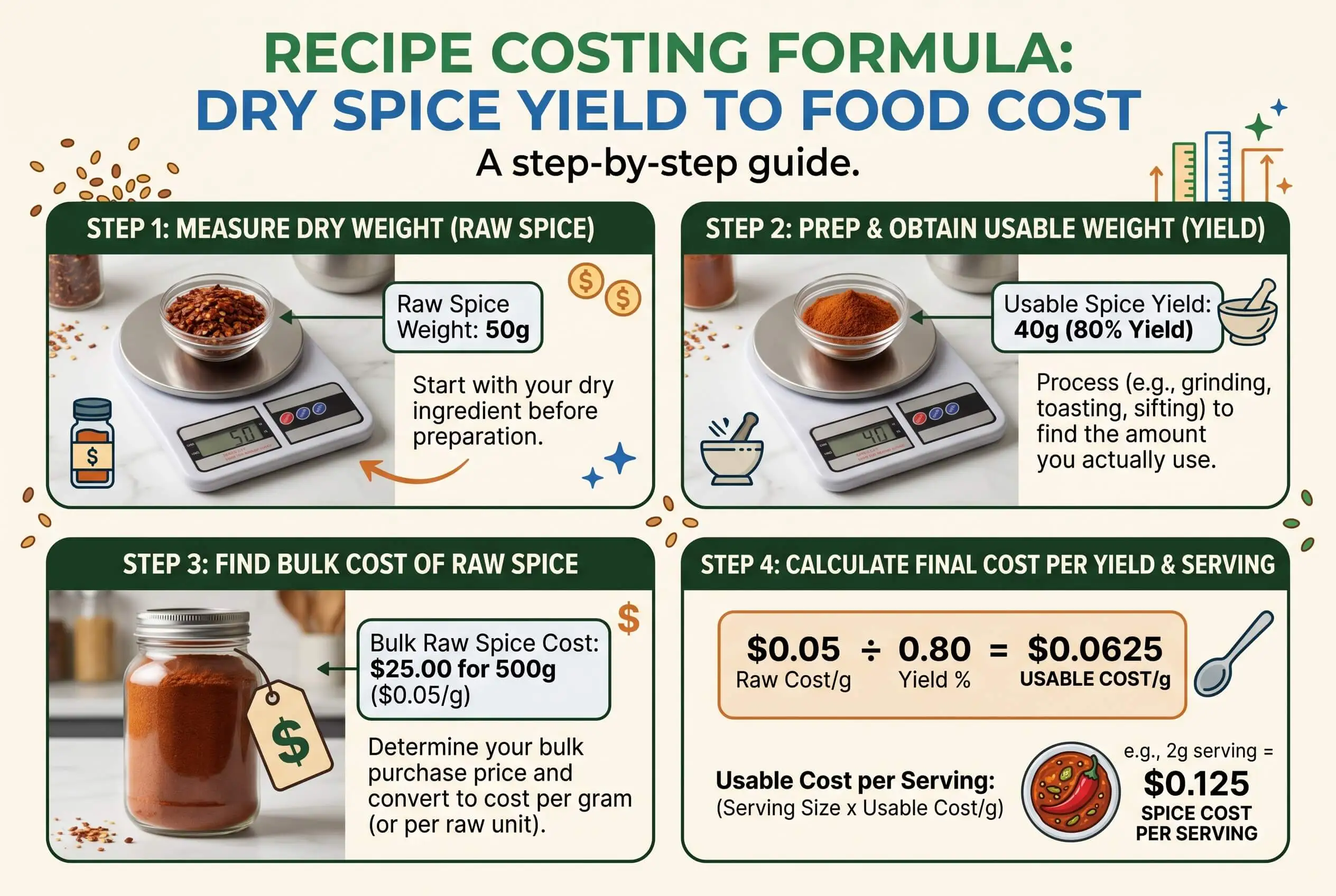
Dry spice yields are the percentage of usable spice you end up with after grinding, sieving, and storage loss take their cut. The formula is yield percent equals edible portion weight divided by as-purchased weight, multiplied by 100.
Typical yields for the spices most working kitchens stock:
Whole black peppercorn to ground: 90 to 95 percent
Whole cumin seed to ground: 92 to 96 percent
Whole nutmeg to ground: 88 to 92 percent
Whole cardamom pod with husk removed: 65 to 75 percent
Bay leaf, whole to crushed: 70 to 80 percent
Why it matters for recipe costing: divide as-purchased cost by yield percent to get true cost per usable ounce. A 10 percent yield error drives roughly a 10 percent plate cost error on spice-heavy dishes.
Top Takeaways
Dry spice yield is a percentage, not a fixed conversion. It varies by spice, form, storage age, and prep method.
Yield errors drive recipe costing errors. A 10 percent miss on yield translates into roughly a 10 percent miss on plate cost for spice-heavy dishes.
Ground spices lose effective yield as volatile oils dissipate, so rotate ground product on a 90 to 180 day cycle to protect both flavor and cost.
Sourcing has a real cost impact. Spices, defined as aromatic seeds, fruits, roots, barks, or other plant substances used to flavor food, vary in yield depending on cultivar, growing conditions, and post-harvest handling.
The formula scales once you build it in. Encode yield percent into your recipe sheets, and every new dish gets accurate spice costing automatically.
What Is Dry Spice Yield?
Yield is a percentage. It tells you how much usable spice you actually end up with after prep, measured against what you bought. Chefs call the starting weight As-Purchased, or AP. The usable weight after grinding, sieving, and any other prep loss is the Edible Portion, or EP. The same ratio governs how we cost peaches, portion ice cream, and price every other ingredient on the line. For a closer look at how the math behind portioning works, our piece on what the numbers on ice cream scoops mean walks through a related example.
Dry spices vary in yield because they don't behave like inert powder. Whole spices lose weight when you grind them, because volatile oils evaporate and fine particles get screened out. Ground spices lose effective yield over time as their potency drops, which forces you to dose more product to hit the same flavor target. Container scrape, grinder retention, and moisture shifts during storage all add to the gap. From AP to EP, the loss can run anywhere from a few percent to double digits. We've seen the gap blow past 30 percent on cardamom pods that were purchased in bulk and held more than a year.
Four levers move the number: spice type, form, storage age, and prep method. All four are variables. Treat them that way and your costing improves automatically.
The Dry Spice Yield Formula
Here's the formula:
Yield Percent = (EP Weight / AP Weight) x 100
Run it on a real bag of whole nutmeg. You buy 16 ounces from a bulk supplier for $24. You toast it, grind it, sieve out the coarse particles, and end up with 14.5 ounces of usable ground product. Your yield is:
(14.5 / 16) x 100 = 90.6 percent
Now extend the math into costing. Your apparent cost per ounce, based on what you bought, is $1.50. You don't actually get 16 usable ounces. You get 14.5. So the true cost per ounce, the one that belongs in your recipe cost sheet, works out to:
$24 / 14.5 = $1.66 per usable ounce
That 16-cent gap between $1.50 and $1.66 is what kills food cost calculations in spice-heavy kitchens. The formula corrects for it before it ever shows up on your P&L.
Step-By-Step Recipe Costing Workflow
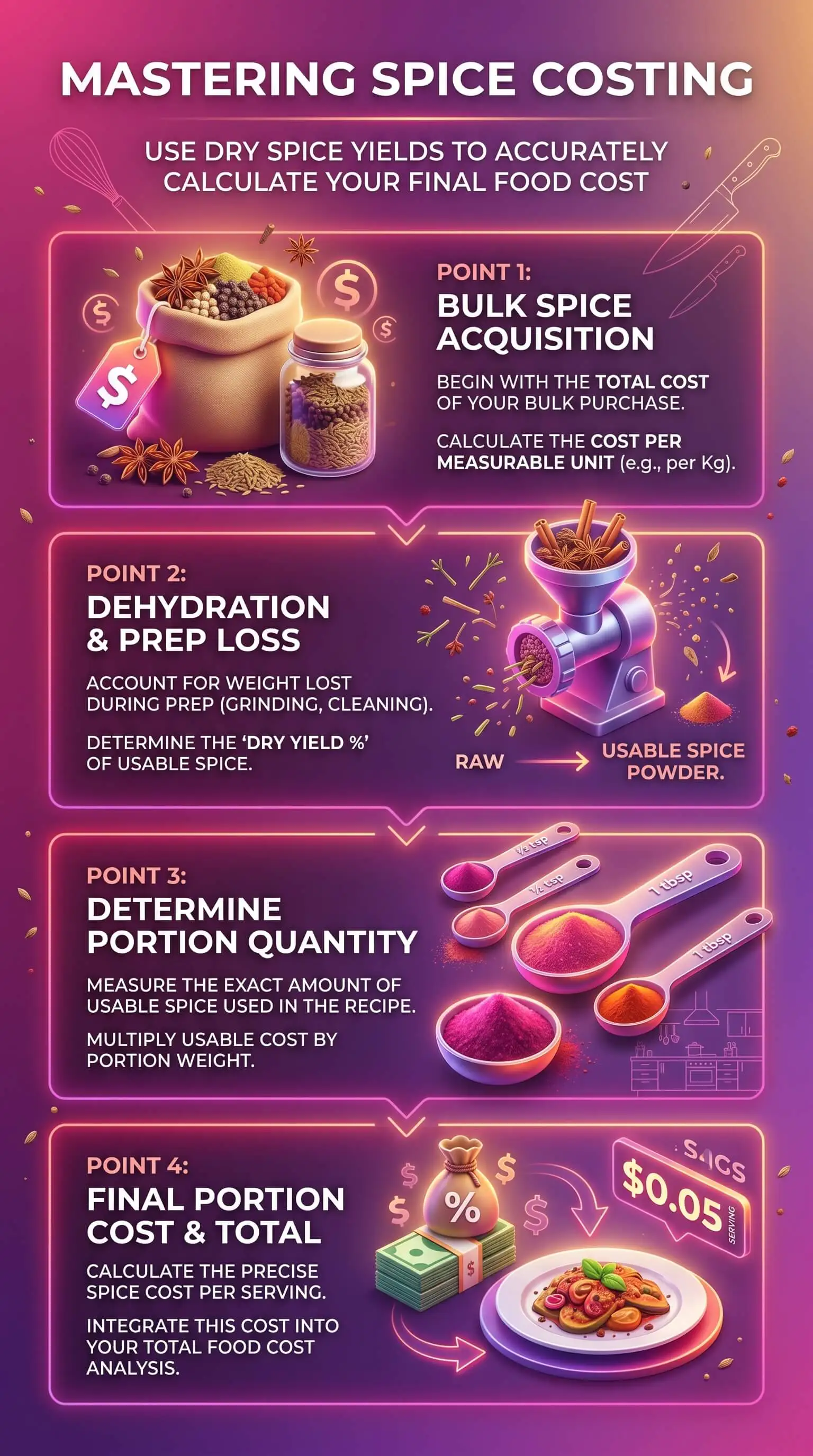
Once you accept that dry spice yields are variables, you need a workflow that builds them into every recipe automatically. Here's the seven-step version we use in kitchens that take spice costing seriously.
Log AP weight and AP cost on intake. The moment a new bag of black peppercorns arrives, record the weight and the invoice cost in your inventory system. Don't wait until prep day.
Establish a yield percent for each spice in each form you stock. Whole peppercorns ground in-house have a different yield from the same peppercorns purchased pre-cracked. Test in-house when you can. Pull from an industry chart when you can't.
Calculate the true EP cost. Divide AP cost by yield percent to get cost per usable unit.
Apply EP cost to recipe quantity. A recipe calling for a teaspoon of ground cumin should use EP cost per gram, multiplied by the gram weight of one teaspoon, not the AP cost.
Itemize spice costs on your recipe cost sheet. Don't roll them into one “seasonings” line. A lumped figure hides yield problems exactly where you need to see them.
Reconcile monthly. Compare theoretical spice usage based on recipes sold against actual inventory depletion. A consistent gap means your yields are wrong, your portioning is sloppy, or both.
Re-test quarterly. Suppliers change. Crop seasons change. Yields drift.
A workflow that ties this discipline to clean operational habits closes the loop before the leak shows up on your P&L. Our guide on station management tips for restaurant kitchens walks through the broader operational scaffolding that keeps this kind of discipline alive past week three.
Common Dry Spice Yield Conversions
The list below covers the dry spices most commonly stocked in working kitchens. Use it as a starting point, then verify against your own product, your own grinder, and your own storage conditions. Yields drift over time. An industry chart gives you a baseline, not a final number.
Black pepper. Whole peppercorn to ground. Typical yield 90 to 95 percent. Lower yields with older stock or finer grinds.
Cinnamon. The whole thing sticks to the ground. Typical yield 80 to 88 percent. Stick fibers screen out at higher rates than seed spices.
Nutmeg. Whole nut to ground. Typical yield 88 to 92 percent. Toasting before grinding boosts flavor yield and slightly reduces weight yield.
Allspice. Whole berry to ground. Typical yield 90 to 95 percent. Behaves similarly to peppercorn in commercial grinders.
Cumin. Whole seed to ground. Typical yield 92 to 96 percent. High oil content reduces evaporative loss.
Coriander. Whole seed to ground. Typical yield 90 to 94 percent. Husk fragments often screened out.
Cardamom. Whole pod to ground with husk removed. Typical yield 65 to 75 percent. Pod husk is significant waste and needs to be accounted for in costing.
Bay leaf. Whole leaf to crushed. Typical yield 70 to 80 percent. Stem and vein removal accounts for most of the loss.
Cardamom is the outlier on this list. The pod husk runs 25 to 35 percent waste, and any kitchen working with whole pods needs to bake that loss into its costing math. Every other row should still be verified against in-house testing before it goes into a final recipe cost sheet. Industry charts age, and your yields will drift away from any baseline you start with.
Hidden Costs Chefs Overlook
Even chefs who run a clean yield formula tend to miss four hidden cost vectors.
Grinder retention loss. Commercial spice grinders trap a measurable amount of input weight in the chamber, the blade housing, and the discharge chute. The trapped product usually runs 1 to 3 percent of the input weight, and it doesn't transfer cleanly to the next batch. Cross-contamination concerns mean you can't simply count it as future-use inventory.
Sieve and tare loss. When you screen ground spices to remove husks and coarse particles, the discarded fraction has cost. A pound of whole coriander that yields 14 ounces of usable ground product after sieving means two ounces of cost went into the bin. Some of that loss is unavoidable. If your sieve mesh is too fine, you're throwing away money.
Potency decay. This one is the silent killer. Ground spices lose volatile oils over time, and the longer they sit, the more you have to dose to hit the same flavor profile. A six-month-old jar of ground cumin might require 50 percent more product to match the flavor of fresh-ground. We've tested this in our own kitchen, and the result was uncomfortable enough that we rebuilt our spice rotation schedule the following week.
Container scrape. The half-teaspoon clinging to the inside of every empty bulk jar adds up over a year. So does the dust at the bottom of every spice bin. Neither shows up in your inventory count. Both came out of your invoice cost.
Organic and Bulk Spice Yield Considerations
Sourcing changes the math in ways that show up directly on plate cost. Organic and single-origin spices often have less standardized moisture content than commodity-grade products, which means the yield can run slightly higher or slightly more variable depending on cultivar and post-harvest handling. A small kitchen that runs tight yield discipline can usually capture more flavor per dollar from organic whole spices, because the volatile oil content tends to be higher and the freshness window longer. The trade-off: organic yields need more frequent in-house testing because the variance is real.
Bulk purchasing improves your AP unit cost but does not always improve your EP cost. Buying 5 pounds of whole cumin instead of 1 pound drops your per-pound invoice number. It doesn't drop your true cost per usable ounce unless you actually use the bulk inventory before potency decay erodes effective yield. The math only works when your usage matches your purchase size.
The cleanest play in most kitchens is whole organic spices, ground in-house close to service. That combination preserves volatile oils, captures the highest flavor return per dollar, and aligns with the same kitchen discipline that informs the organic prep work we walk through in our guide on how to blanch peaches perfectly using organic farming techniques.
“In a working kitchen, the most overlooked variable in plate cost analysis is what happens to spice between the bag and the bowl. Most chefs can quote their protein cost to the cent. Ask them their effective cost per usable ounce of ground cumin and the room goes quiet. That gap is where the margin disappears.”
7 Essential Resources
These references give you the data, the technical standards, and the working tools that sit behind accurate dry spice yield calculations. Bookmark them.
USDA FoodData Central. The federal nutrition database, with detailed composition data for whole and ground spices, including moisture content figures that drive yield variance.
American Spice Trade Association (ASTA). The U.S. industry body that publishes cleanliness specifications, quality grades, and analytical methods for dry spices. Worth knowing if you want to benchmark your product against industry standards and understand where sieve loss originates.
National Restaurant Association. Publisher of the State of the Industry report, which is the benchmark source for food cost percentages, prime cost ratios, and operating metrics across U.S. restaurant segments.
ReFED. A nonprofit research organization with current data on food waste in restaurants and foodservice. Useful framing for the broader yield-loss conversation and for benchmarking your kitchen against national waste reduction data.
The Culinary Institute of America. Source of The Professional Chef, which is the textbook reference for kitchen yield testing, standardized recipe development, and commercial costing methodology.
ServSafe. Industry-standard food safety certification with detailed guidance on spice storage, dating, and rotation. Storage discipline directly affects effective yield over time.
Restaurant365. A restaurant accounting and inventory platform that handles yield percent inside its recipe costing module. A practical example of how the formula gets encoded into daily operations at scale.
3 Statistics
1. Industry-average restaurant food cost. Restaurant food cost benchmarks now sit between 28 and 35 percent of revenue, with the industry-wide average reaching 32.4 percent according to the 2026 National Restaurant Association State of the Industry report. Spice line accuracy is one of the smaller factors that determines whether an operator lands in the profitable end of that range. Source: Whipplewood CPAs benchmark analysis citing the 2026 NRA State of the Industry report.
2. Global spices and seasonings market size. The global spices and seasonings market was valued at $29.49 billion in 2024 and is projected to reach $48.16 billion by 2033, growing at a 5.6 percent compound annual rate. The category is growing faster than overall foodservice, which means accurate spice costing matters more each year. Source: SkyQuest Technology Seasoning and Spices Market Report.
3. U.S. foodservice surplus food. U.S. foodservice operations generate an estimated 12.5 million tons of surplus food annually, with a wholesale value of about $157 billion, according to ReFED's 2024 data. Yield-loss vigilance at the spice level is a small slice of that total. It's also one of the most fixable through tight workflow discipline. Source: ReFED, Food Waste Tracking analysis.
Final Thoughts and Opinion
Dry spice yield is a margin tool. Treating it as culinary trivia is how operators end up wondering why their food cost percentage drifted up another point this quarter. The formula is simple. Yield percent equals EP weight divided by AP weight, multiplied by 100. What separates kitchens that hit their food cost target from kitchens that wonder where the money went is the discipline of applying that formula to every recipe, every supplier change, every quarter.
Here's our opinion. Whole organic spices, ground close to service, almost always win on effective yield and flavor return per dollar. The premium per pound is real. So is the higher volatile oil content, the longer freshness window, and the lower potency decay. For a kitchen running tight on margin and serious about flavor, cleaner sourcing pays for itself inside one quarter of disciplined yield testing. What we've observed in operations that make this switch: the food cost percentage settles within six weeks, the line cooks stop second-guessing their dosing, and the margins quietly recover. The numbers tend to follow the discipline.
Frequently Asked Questions
What is the dry spice yield formula?
The dry spice yield formula is yield percent equals edible portion weight divided by as-purchased weight, multiplied by 100. It tells you how much usable spice you get after grinding loss, sieve waste, and moisture variance are accounted for. Apply the yield percent to your invoice cost to find the true cost per usable ounce.
How do you calculate spice cost in a recipe?
Calculate spice cost in a recipe by first finding the true cost per usable unit. Divide the as-purchased cost by the yield percent to get edible portion cost. Multiply that by the quantity the recipe calls for. Total all spice line items individually. Don't lump them under a single seasonings category, because that hides costing errors.
Why do whole spices have a higher yield than pre-ground?
Whole spices have higher effective yield than pre-ground because they retain volatile oils longer. Pre-ground spices begin losing flavor potency within weeks of grinding, which forces you to dose more product to hit the same flavor target. That overdosing is a hidden yield loss. Whole spices ground close to service preserve both flavor and yield.
How often should restaurants test dry spice yields?
Restaurants should test dry spice yields quarterly at minimum, and any time a new supplier or product format enters the inventory. Yield drifts as suppliers change crops, as grinders age, and as storage conditions shift. Quarterly testing keeps your recipe cost sheets honest. Operations with seasonal menus should test alongside each menu transition.
Do organic spices have different yields than conventional?
Organic spices often show slightly different yields than conventional, with somewhat higher variance because of less standardized moisture content. Organic whole spices typically carry higher volatile oil content and a longer freshness window, which improves effective yield over time. The trade-off is the need for more frequent in-house yield testing per supplier and per lot.
What is the difference between AP weight and EP weight for spices?
AP weight is the as-purchased weight on your invoice. EP weight is the edible portion weight that actually goes into recipes after grinding, sieving, and any other prep loss. The gap between AP and EP is your yield loss. Recipe costing built on AP weight alone understates the true cost per usable ounce.
How does spice storage affect recipe costing?
Spice storage affects recipe costing because volatile oils dissipate over time, which reduces effective potency. As potency drops, the dose needed to hit the same flavor target rises, which raises real spice cost per dish without ever showing up on the invoice. Tight-sealed containers, cool storage, and a 90 to 180 day rotation cycle protect effective yield.
Can I use a yield chart instead of testing my own?
You can use a published yield chart as a starting baseline, but verify the numbers against your own product, your own grinder, and your own storage conditions. Industry charts give you the right order of magnitude. They don't account for the moisture content of your supplier's specific lot or the wear pattern of your equipment. Test against your own setup before you trust any chart.
Take The Next Step
If this guide helped you tighten one line in your recipe cost sheet, it earned its keep. The next step is to apply the formula to every spice on your rack, document the yields, and rebuild your recipe sheets around true edible portion cost rather than as-purchased cost. Bookmark this page, share it with your sous chef, and come back when you're ready to dig into bulk organic sourcing or related kitchen efficiency topics. Precise spice yields protect your margin, sharpen your flavor, and honor the work that went into growing the spices in the first place. Every recipe sheet you build should be something you can defend.